CheckAIMed: intelligent quality control of medical documentation
CheckAIMed is software for AI-assisted preliminary analysis of medical documentation to support internal quality control. It helps identify information that may be missing, inconsistent, or require expert review against criteria configured by the medical organisation.
- up to 80%fewer fines
- up to 3,000documents per hour
- 100%medical record review
- 152-FZcompliance
Regulatory requirements and standards taken into account
CheckAIMed supports configurable review criteria based on applicable Russian regulations, clinical guidelines and internal policies. The medical organisation determines which requirements apply to its services and workflow.
The challenges we solve
Familiar clinic pain points, automated and resolved.
-
Manual review takes hours every day
Physicians and experts spend a significant share of their working time reviewing records instead of treating patients.
-
Errors are detected too late
Documentation defects may be identified during internal or external review and can create financial and operational risk. Preliminary review helps the organisation address documentation issues earlier.
-
Financial sanctions and fines
Documentation defects can contribute to findings in external reviews.
-
Insurer denials
Documentation defects can be among the reasons why payment for medical care is questioned by insurers.
-
Heavy workload for physicians and clinical expert review staff
Chronic staff overload leads to burnout and a decline in the quality of work with documentation.
-
The workload on physicians can be reduced
Automated voice-based completion of the physician's record, AudioProtocol, reduces manual entry and relieves physicians: they review and approve a ready draft.
Who CheckAIMed is for
Every participant in the process gets their own view of the results, from management analytics to clear findings on a specific document.
CheckAIMed helps the chief medical officer and the quality department build an internal quality control system with uniform review criteria and centralized analytics. Internal quality and safety control of medical activity covers the cases, departments, and specialists of the medical organization submitted for analysis.
-
Clinic owner / director and chief medical officer
- A unified view of the quality of medical documentation and care across the entire clinic, departments, and physicians, without manual reports.
- Fast detection of systemic defects, problem areas, and recurring errors.
- Helps reduce the risk of financial losses in CHI fund reviews and supports preparation for scheduled and unscheduled inspections.
-
Internal control department
- A shift from sample-based review toward analysis of all submitted cases
- Uniform internal criteria configured by the medical organisation, taking into account applicable regulatory and payer requirements. The system does not reproduce or replace an external review methodology.
- Review log and history of finding resolution
-
Head of department
- Recurring defects of individual physicians and how they change over time
- Prioritization of cases that need attention, without manual sorting
- A tool for objective feedback to physicians
-
Physician
- Clear findings on documentation that is already prepared, with no new requirements
- The rationale for every finding: what exactly was checked and why
- Fewer corrections after external review
Medical record review and control of medical documentation practices
CheckAIMed analyzes the completeness, chronology, and consistency of information in the documents of a single case. The system identifies medical documentation errors, recurring documentation defects, missing information, and contradictions between documents.
-
Documentation completeness
The system checks whether configured sections, signatures and data fields are present in the submitted documentation and highlights items that may require review.
-
Consistency with configured criteria
Documentation consistency with configured clinical and quality criteria. The system compares the submitted record with criteria derived from applicable clinical guidelines and internal rules; it does not assess clinical correctness or make a clinical decision.
-
Legal requirements
Configured regulatory, payer and internal documentation criteria can be included in a preliminary review. The applicable criteria, their current versions and their interpretation are approved by the medical organisation.
-
Logic and format checks
Chronology, absence of typos, date and unit formats, and required entries.
Automated review of medical documentation in CheckAIMed is implemented as a preliminary intelligent analysis. The review results help the expert physician find cases that require attention, but do not replace medical expert review or the professional opinion of a specialist.
System features
9 review modules: click a card to see the workflow diagram, description, and criteria table. Plus AudioProtocol: voice-based completion of consultation records.
What the system helps with
- Earlier
Earlier detection
The system helps identify documentation issues in the records submitted for analysis and prioritise them for expert review.
- Focused
Expert attention
Expert attention can be directed to the records and findings flagged for review.
- Full set
Records analysed
Analysis of the full set of records submitted for review.
- At scale
Preliminary analysis
Automated preliminary analysis of large volumes of submitted documents.
Four steps of preliminary documentation review
A simple and transparent process, with no complex implementation.
-
Upload and security
- Upload via API or web portal in any convenient format.
- Integration options are assessed for each hospital information system (HIS).
- De-identification of patients' personal data before AI processing.
-
Intelligent AI analysis
- Preprocessing and parsing of medical record data.
- The medical organisation approves the applicable review criteria and clinical-guideline mapping.
- CheckAIMed performs a preliminary analysis against these criteria.
-
Error marking and audit
- Marking of possible issues directly in the document text.
- Calculation of documentation quality indicators for quality-improvement analytics.
- Escalation of complex cases to a dedicated expert module for manual validation.
-
Report and results storage
- Sending the completed report and recommendations back to the HIS or to your monitoring dashboard.
- Automatic logging of all system and user actions.
- Saving the history of review results for subsequent expert validation.
Monitoring dashboard for medical documentation quality
Control quality in real time with a single monitoring dashboard. Get summary analytics for the clinic, departments, physicians, and individual medical documents, quickly identify problem areas, and make data-driven decisions.
-
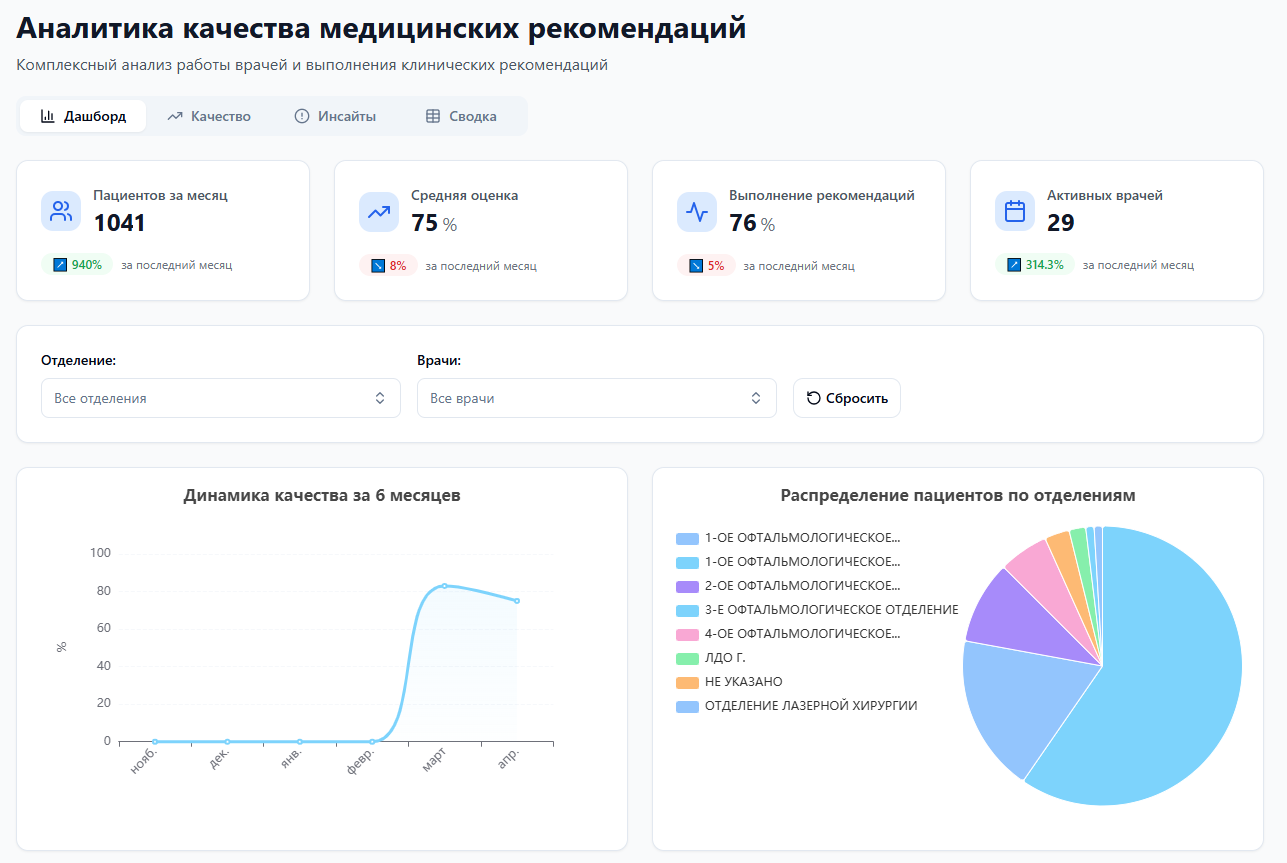
Overall analytics
Key indicators, the number of documents reviewed, the level of compliance with requirements, and the most common errors.
-
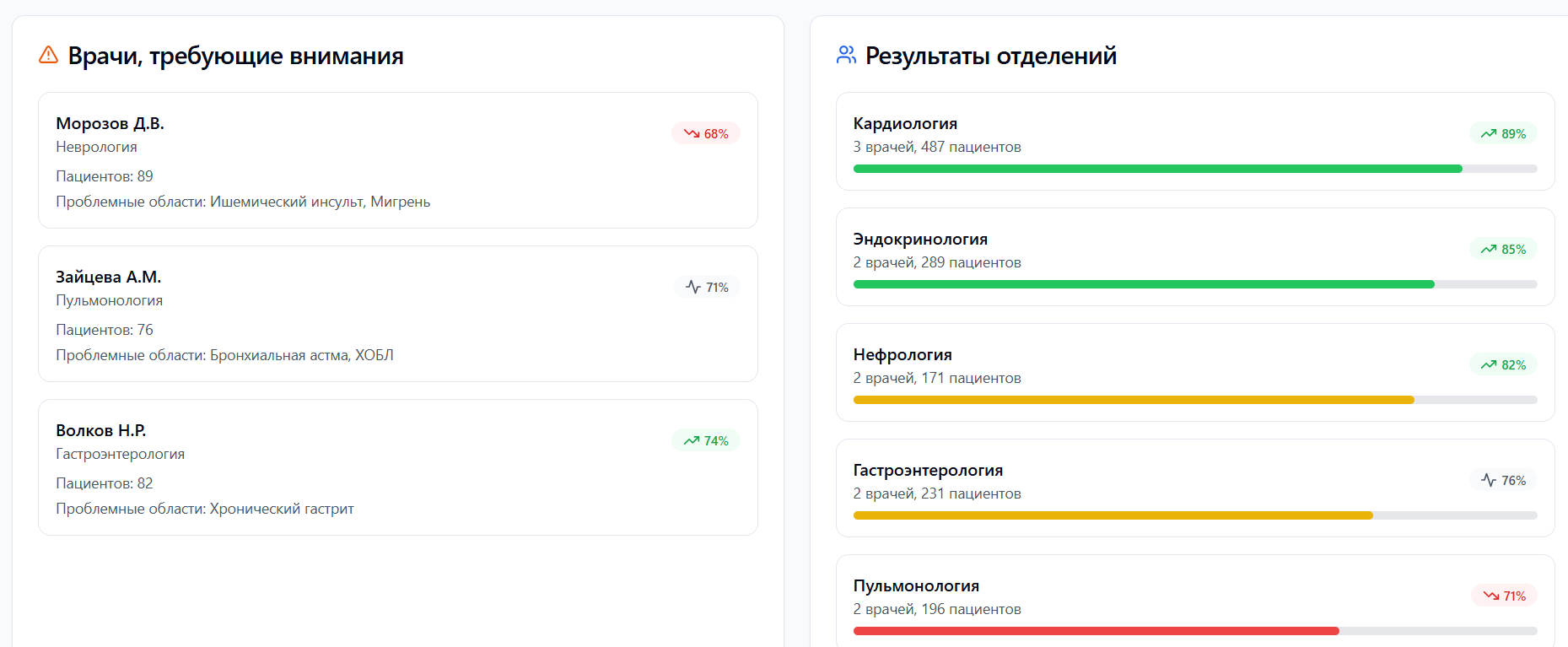
Analytics by department and physician
Compare the quality of work across departments and physicians, identify systemic problems, and determine areas that need attention.
-
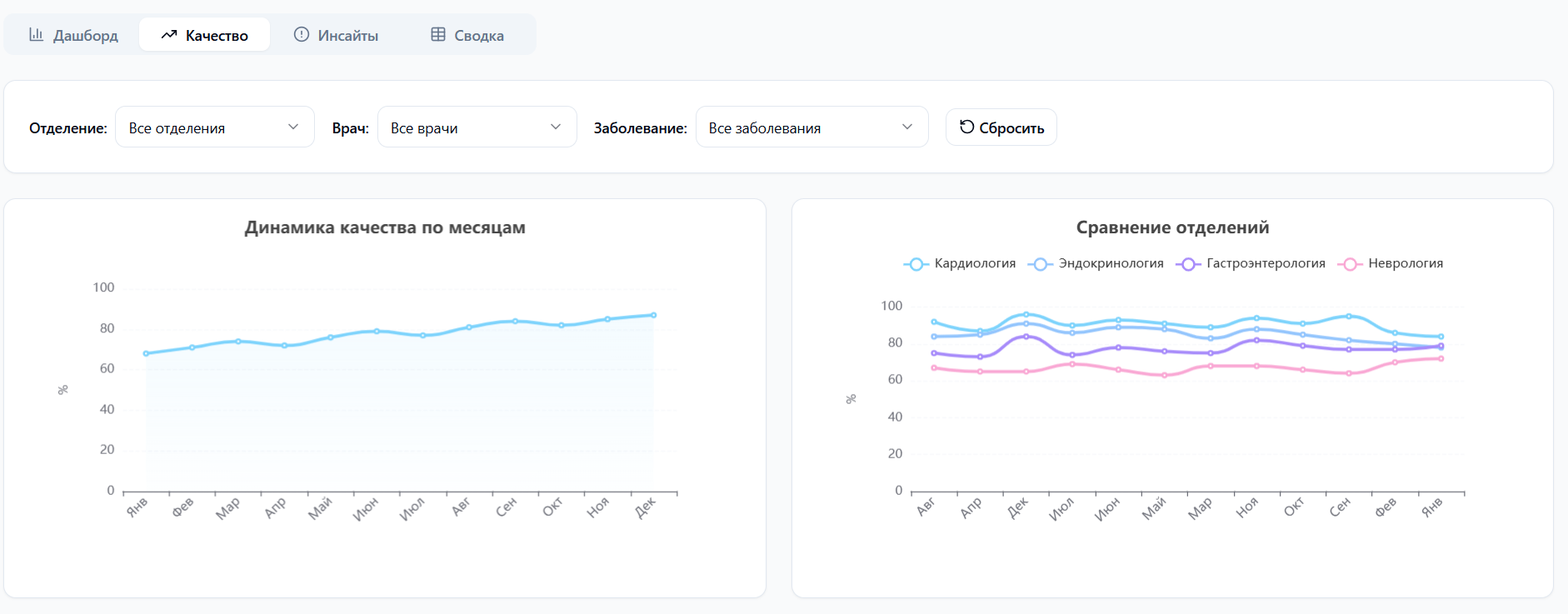
Comparative analysis and trends
Track changes in quality indicators over a period, compare departments, and analyze the effectiveness of implemented measures.
-
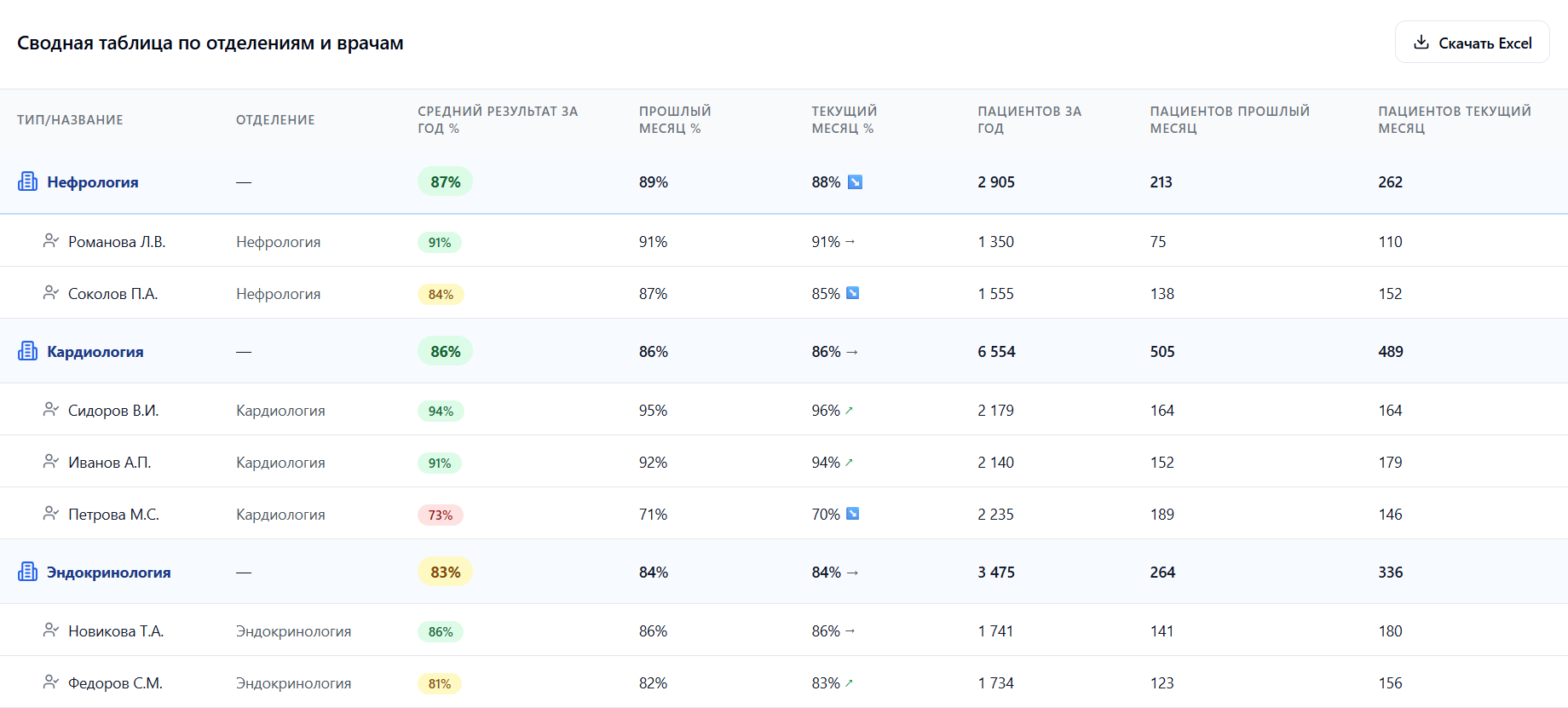
Indicator trends and reports
Generate detailed reports, analyze indicators over time, and use the data for internal quality control and preparation for inspections.
-
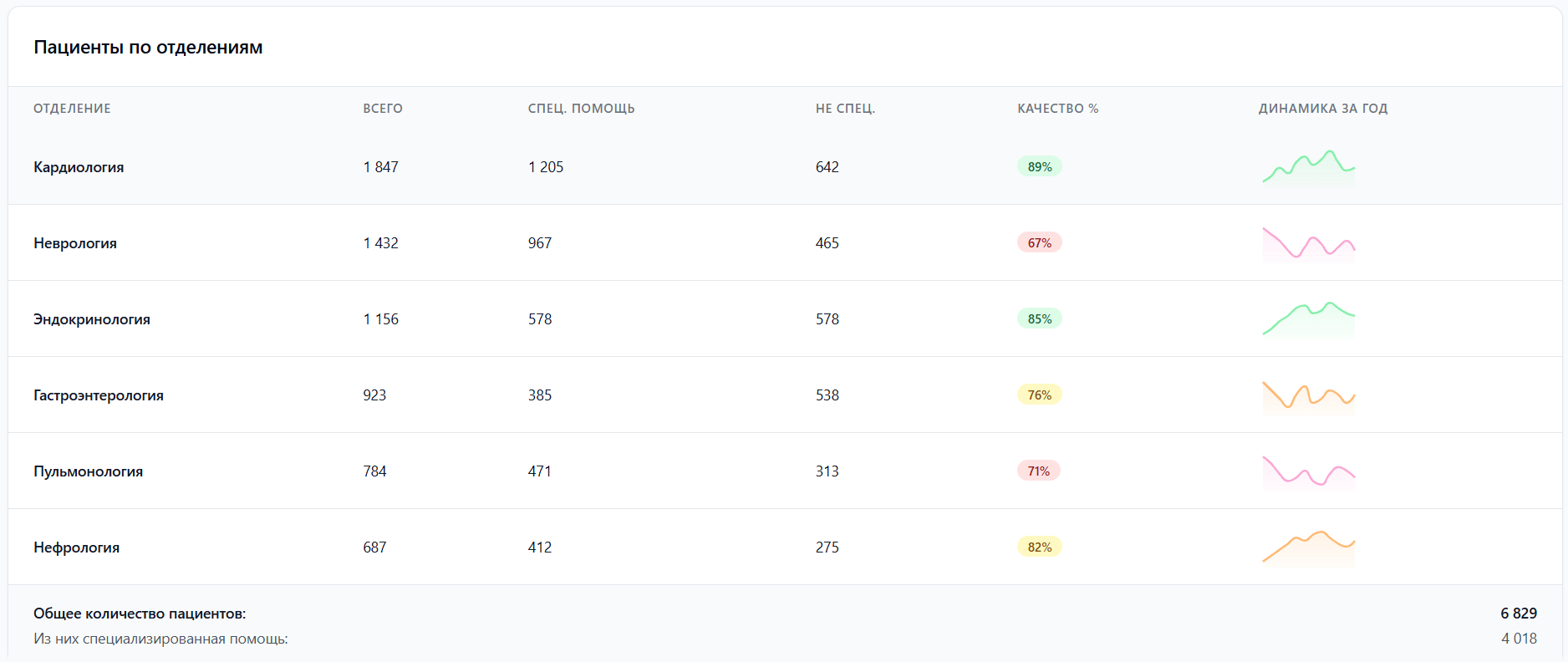
Patient statistics
Analyze the number of patients, the distribution of workload across departments and physicians, and the relationship between the volume of care and documentation quality.
Integrations and partners
Integration options are assessed for each HIS and deployment environment.









Security and personal-data safeguards
Multi-layered protection of patient data at every stage of processing.
-
Personal data protection (152-FZ)
The deployment can support organisational and technical safeguards, including role-based access. The medical organisation remains responsible for determining the legal basis for processing, its security measures and compliance with applicable personal-data law.
-
Document de-identification (anonymization)
The deployment can support de-identification of medical records on the clinic's side, so that the AI model works with depersonalised text. The medical organisation defines and verifies the de-identification procedure.
-
Local AI environment
AI processing is deployed in the clinic's protected IT environment.
-
On-premises deployment
For large clinics and public healthcare networks, the system can be installed on their own servers in a closed internal network.
-
Configurable review criteria
Review criteria can be updated when regulations change; the applicable criteria and versions are approved by the medical organisation.
Pricing
Choose the format that suits you: flexible pay-per-review pricing, a fixed monthly subscription by area, or deployment of an independent system on the clinic's own servers.
Computer program registration certificate No. 2026664457 dated 05/15/2026
-
Document analysis
30 – 50 ₽ per 1 reviewed caseCloud service · Actual review volume- Quick connection and setup on the day of your request.
- Per 1 SMO case (a set of documents, not a single record)
- Access to basic review checklists based on standards of the Russian Ministry of Health.
- Over 5,000 SMO cases per month: discounts!
-
Per-user license
from 5,900 ₽ Monthly fee per user- First month free (after signing the contract)
- Over 10 users: discounts
- Roles available: Physician, Head of Department, Chief Medical Officer.
- Priority 24/7 technical support.
- Delivery of updates to clinical guidelines and Ministry of Health orders.
-
One-time services
99,000 ₽ One-time payment- HIS integration included
- Deployment in a closed internal network.
- Operation within the clinic's closed internal network.
- Personal data is stored on the clinic's server
Expert resources
Practical resources for heads of medical organizations, chief medical officers, and quality department specialists: quality control of medical care, quality review of medical care, medical documentation practices, medical record review, and the use of AI in a medical organization.
-
Quality control of medical care: how to build a system that works
Criteria, medical documentation, defect analysis, corrective actions, and management analytics, with a practical implementation plan for a clinic.
Read the article → -
Internal quality control of medical activity: automation
Organizing internal quality and safety control of medical activity: a unified data model and analytics by department and physician.
Read the article → -
Quality review of medical care and IT support for the expert
How IT and automated preliminary analysis reduce the expert physician's preparatory work in the quality review of medical care.
Read the article → -
AI-based medical record review: errors, completeness, and chronology
Automated medical record review: completeness, deadlines, contradictions, and documentation defects, with an evidence trail for the physician.
Read the article → -
Medical documentation practices: digital quality control
Requirements for maintaining and completing medical documentation, translated into verifiable criteria and digital control across departments.
Read the article → -
Ministry of Health Order No. 785n: automating internal control
A practical look at digitally organizing internal quality control under Order No. 785n of the Russian Ministry of Health: data, roles, reporting.
Read the article → -
Artificial intelligence in medicine: documentation control
Responsible use of artificial intelligence in medicine for document analysis and management analytics, without replacing the physician.
Read the article → -
Medical examination and documentation control with CheckAIMed
Digital control of pre-employment and periodic medical examinations: completeness of documents and examinations, and compliance with Order No. 29n.
Read the article →
CheckAIMed produces analytical information on medical documentation. The system does not establish a diagnosis, prescribe treatment, or replace a physician, a medical commission, or a quality expert.
Answers to your questions
How do I get started with the service?
How long does implementation take?
How accurate is the AI document review?
How is data security ensured?
What technologies does the system run on?
What does the "Not met" status mean?
Ready to improve the quality of your documentation?
We will show how CheckAIMed helps identify documentation issues in your medical records for expert review.